
Chapter 12
Forward Secrecy and Post-Compromise Security
SANKET Technical Security & Architecture Whitepaper. Public edition 2.0, 7 October 2026.
Forward secrecy and post-compromise security are different properties that are often conflated. One protects the past against a future compromise; the other restores protection for the future after a compromise has ended.
12.1 Definitions
- Forward secrecy (FS): If an attacker obtains a party's current key state at time T, messages sent before T remain confidential. The Double Ratchet achieves this because chain keys are advanced through a one-way function and message keys are deleted after use, so earlier keys cannot be recomputed.
- Post-compromise security (PCS), or break-in recovery: If an attacker obtains key state at T but then loses access, messages sent after the next Diffie-Hellman ratchet step that the attacker did not observe are confidential again. The Double Ratchet achieves this by mixing fresh ephemeral X25519 agreements into the root key.1
Both properties have been established for the Signal Protocol in peer-reviewed formal analysis.2 SANKET inherits them by using libsignal unmodified; it does not claim to have independently re-proved them.
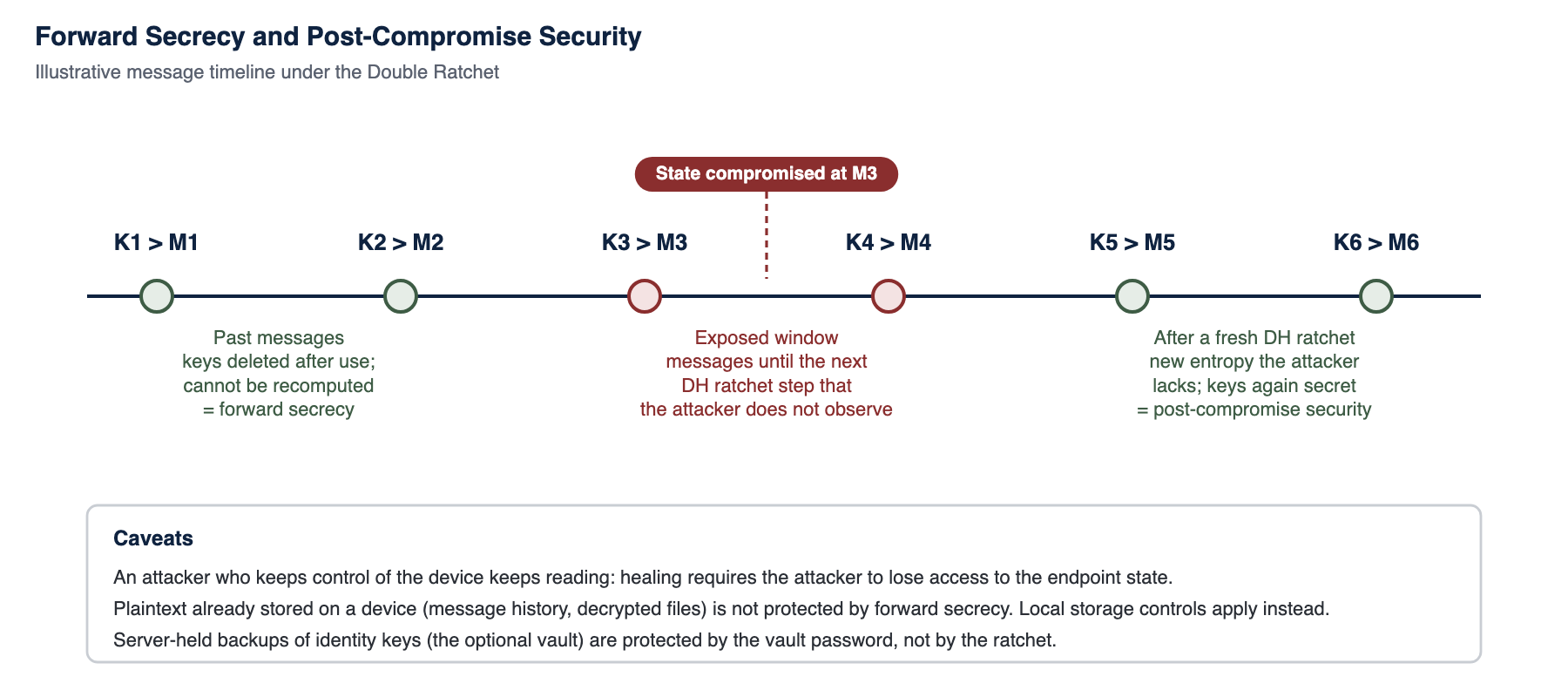
Figure 5: Forward secrecy and post-compromise security on a message timeline
12.2 Worked Timeline
Table 21: Effect of a key compromise at message M3
| Message | Key | Status after compromise of session state at M3 | Why |
|---|---|---|---|
| M1 | K1 | Protected | K1 was deleted after use and cannot be derived from later chain keys |
| M2 | K2 | Protected | Same as M1 |
| M3 | K3 | Exposed | The attacker holds the state that derives K3 |
| M4 | K4 | Exposed if sent before the next DH ratchet | Symmetric ratchet steps are computable from the compromised chain key |
| M5 | K5 | Protected after a DH ratchet the attacker did not observe | A new ephemeral X25519 agreement contributes entropy the attacker lacks |
| M6 | K6 | Protected | Recovery persists while the attacker remains out of the endpoint |
12.3 Behaviour in SANKET Specifically
- Per device pair. Because group messages are pairwise fan-out, every recipient device has its own ratchet. A compromise of one session does not expose other members' sessions.
- Reactions and encrypted broadcasts. Both travel as libsignal messages with the same per-device Double Ratchet properties. An encrypted broadcast is encrypted by the broadcast-sender desktop for every recipient device through its own session, with no sender keys, so it has the same forward secrecy and post-compromise security as a one-to-one message; its server-side copy for a device is deleted as soon as that device confirms it has stored the broadcast, and otherwise at expiry.
- Server-side ciphertext lifetime. Delivered ciphertext is removed from the server after a short window, so a later server compromise cannot collect long history to combine with a later key compromise.
- Session repair. When a session is reset after repeated decryption failure, a fresh PQXDH handshake starts a new ratchet; this also refreshes the post-quantum contribution.
- Calls. Every call, one-to-one included, has its own server-issued call id that names its media room and binds its frame keys, so nothing from an earlier call can enter a later one. Call sender keys ratchet forward every 200 ms with HKDF and are replaced with fresh random keys whenever a participant joins or leaves, giving forward secrecy at the granularity of a key epoch and preventing joiners from decrypting earlier media or leavers from decrypting later media.
- Post-quantum dimension. PQXDH protects the initial handshake against harvest-now-decrypt-later, and the SPQR ratchet in the libsignal release in use extends forward secrecy and post-compromise security with a post-quantum component (Chapter 39).
12.4 Scope of the Properties
Note
Note - What forward secrecy does not do
-
It does not protect plaintext already stored on a device. Message history in the local encrypted database is protected by local storage controls and the device's lock, not by the ratchet.
-
It does not heal an attacker who keeps control of the endpoint. Post-compromise security requires the attacker to lose access to the key state.
-
It does not protect a user's identity key held in the optional vault backup. That copy is protected by the vault password.
-
It does not apply to routing metadata or to notice broadcasts (the announcement type that is labelled as not end-to-end encrypted), which are handled by the server as described in Chapter 20. Replies, reactions, classification labels, encrypted broadcasts, link previews, locations, contact cards and forwarded-message references travel inside the ciphertext and are covered.
Footnotes
-
T. Perrin, M. Marlinspike, "The Double Ratchet Algorithm", Signal specification. signal.org/docs/specifications/doubleratchet/ ↩
-
K. Cohn-Gordon, C. Cremers, B. Dowling, L. Garratt, D. Stebila, "A Formal Security Analysis of the Signal Messaging Protocol", IEEE EuroS&P 2017; extended version in Journal of Cryptology 33, 2020. ↩
Evaluating SANKET for your organisation?
Talk to Tosh Defence about a technical briefing, a deployment plan for your infrastructure, or the controlled edition of this whitepaper under a non-disclosure agreement.