
Chapter 20
Metadata Security
SANKET Technical Security & Architecture Whitepaper. Public edition 2.0, 7 October 2026.
End-to-end encryption hides what is said. It does not, by itself, hide who said it, to whom, when, how much or from where. For many high-trust organisations that metadata is as sensitive as content, so this chapter sets out exactly what SANKET's server handles.
20.1 Metadata Inventory
Table 38: Metadata handled by the server in the described release
| Metadata | Visible to server? | Why it is needed | Minimisation and retention |
|---|---|---|---|
| Sender account and device of each message | Yes | Authorisation, routing, receipts, audit | Required for accountability in an organisational platform; sealed sender is not provided |
| Recipient devices of each message | Yes | Fan-out delivery | Per-device rows tombstoned 72 h after delivery |
| Conversation membership and group names | Yes | Access control | Group names and descriptions are stored in clear |
| Timestamps and delivery / read state | Yes | Ordering and receipts | Read receipts and typing can be disabled by policy and user |
| Ciphertext size | Yes, as a size band | Inherent to any transport | Padded to 160-byte blocks; disappearing messages and short server-side retention limit its value |
| Message adjuncts (reply excerpts, link previews, locations, contact cards, forwarded-from) | No (inside ciphertext) | Carried in the end-to-end encrypted content envelope | Not stored by the server outside the ciphertext; each feature controllable by policy |
| Reactions | No (inside ciphertext) | Sent as end-to-end encrypted messages; each device computes the counts | Opaque per-device rows tombstoned like messages; optional emoji-free count for large groups, off by default (the server then learns who reacted to which message, never the emoji); disable by policy |
| Classification labels | No (inside ciphertext) | Carried in the end-to-end encrypted envelope for each message and attachment | The label list itself is tenant configuration, never sent to unauthenticated callers; devices report coarse label events to the audit log without message or conversation identity (Chapter 38) |
| Encrypted broadcasts: priority, audience, deadline, expiry, receipts | Yes (title, body and attachments: No, inside ciphertext) | Fan-out to every recipient device, acknowledgement, deadline and escalation | Per-device ciphertext deleted once each device confirms storage, otherwise at expiry; push and alerts carry identifiers, priority and deadlines only (Chapter 17) |
| Notice broadcasts: title, body, attachments | Yes | Non-sensitive announcements from the administrator console, labelled as not end-to-end encrypted | Retention 90 days by default |
| Call metadata (participants, type, start, duration, caller display name in offer) | Yes | Signalling, one-call-per-device, call logs | Call logs retained 365 days by default and rolled up |
| Device information (platform, model, app version, hardware protection level, client certificate fingerprint) | Yes | Compatibility, update enforcement and device governance; binding the device certificate to the device record | Shown to administrators; device certificates carry an opaque random name, no user or device identifier |
| IP addresses and user agents | Yes | Abuse prevention and audit | In audit records; masked identifiers in edge logs |
| Sign-in and security events | Yes | Security and accountability | Audit log retained per policy (Chapter 21) |
| Account profile (Sanket ID, display name, email, phone) | Yes | Directory and verification | Phone and email optional; stored in clear |
| Identity-provider mapping (when federated sign-in is configured) | Yes | Linking the customer's own identity provider or directory to administrators and to Sanket IDs | No account is created from the provider; provider secrets held in the key service (Chapter 13) |
| Signed device lists | Yes | Letting senders verify every recipient device before encrypting | Append-only log of each account's signed lists; reveals the same devices and device kinds as the device inventory |
| Usage analytics | Yes, pseudonymous (when on) | First-party usage statistics | On by default; the organisation can switch it off and an installation-level lock can force it off, after which nothing is collected; counts only, no content, no third party; rollup retention configurable (Chapter 22) |
| Push wake-ups | Partially (to relay) | Waking devices | Content-free: sealed or generic payloads carrying only routing identifiers, with fixed size and decoy traffic where the platform allows. Wake-ups for encrypted broadcasts carry no content, only a generic text by priority |
20.2 What SANKET Does to Minimise Metadata
- Self-hosting keeps all metadata within the customer's boundary; nothing is sent to Tosh Defence except, if enabled, a signed status report containing counts of users, administrators and groups and the release version.
- Content-free notifications by default: no sender name and no preview.
- Reactions, encrypted broadcasts and classification labels inside the ciphertext, so the server holds none of their content.
- Sealed wake-ups that hide which events occurred, padded to a fixed size and mixed with decoy traffic where the platform allows.
- Non-enumerable directory: users can find others only by exact Sanket ID or among people they already share a group with.
- Short server-side ciphertext lifetime and configurable retention windows.
- Edge logs mask identifiers that appear in request paths.
- Last-seen visibility can be restricted to contacts or nobody.
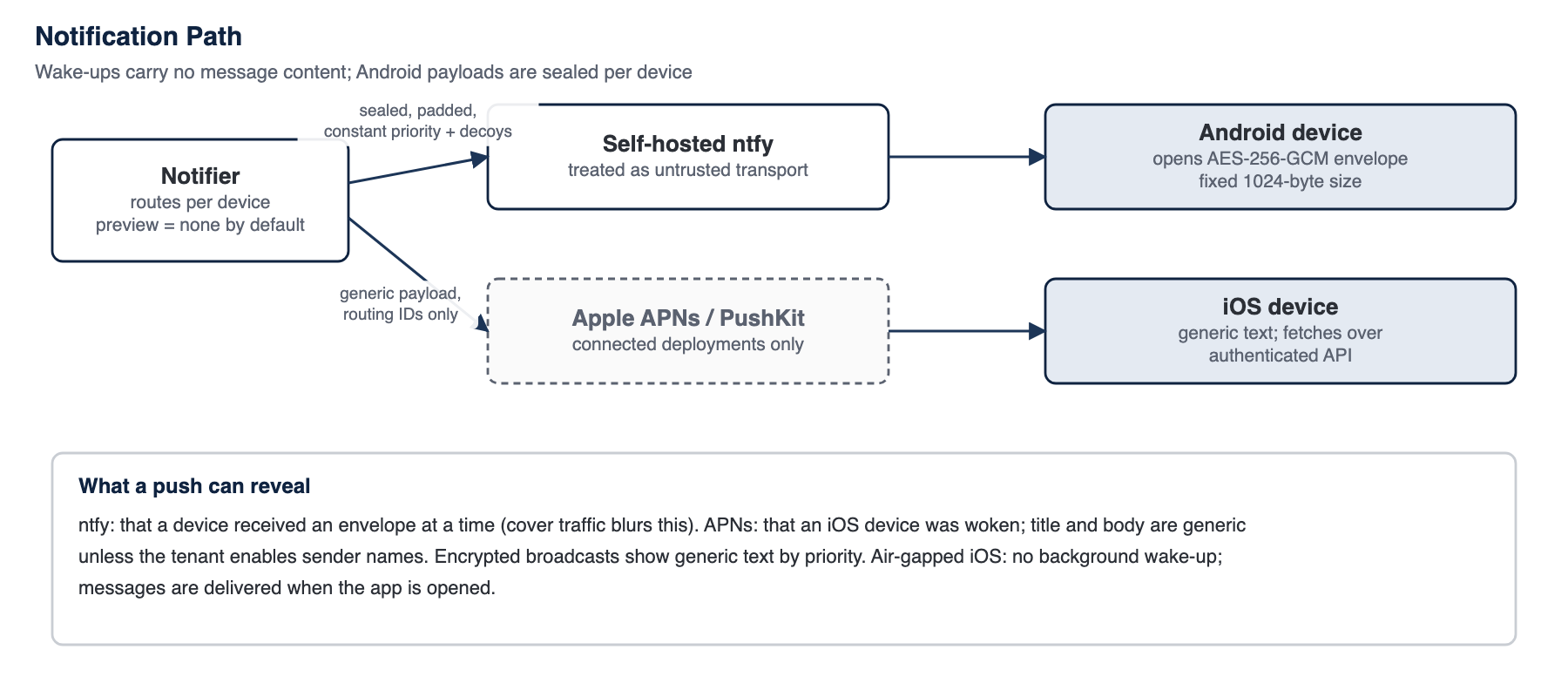
Figure 12: Notification path
20.3 Content Confidentiality Versus Traffic-Analysis Resistance
SANKET provides strong content confidentiality. It does not provide traffic-analysis resistance against the operator of the installation, nor against a network observer who can see device-to-installation traffic volumes and timing. Systems that resist traffic analysis use techniques such as sealed sender, constant-rate cover traffic, mixing or onion routing,1 which carry significant cost. SANKET does not provide sealed sender: the server sees the sending account and device of every message. For most customers the decisive mitigation is that the operator is the customer itself; where insider metadata analysis is a concern, access to the database and audit records should be separated and monitored (Chapter 27).
Footnotes
-
Signal, "Technology preview: Sealed sender for Signal", signal.org/blog/sealed-sender/, October 2018. ↩
Evaluating SANKET for your organisation?
Talk to Tosh Defence about a technical briefing, a deployment plan for your infrastructure, or the controlled edition of this whitepaper under a non-disclosure agreement.